
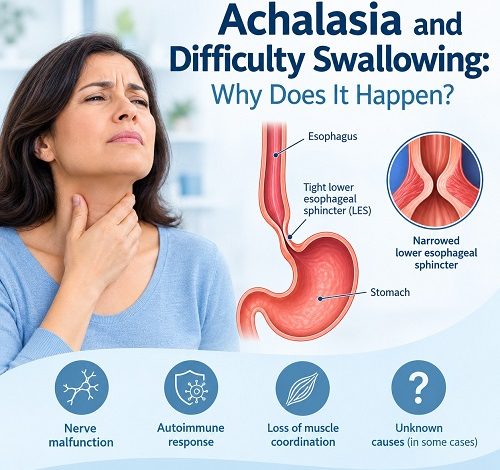
Achalasia and difficulty swallowing are closely connected because achalasia affects the normal movement of food through the oesophagus. People with this condition may feel that food or liquid is getting stuck in the chest or throat, making eating and drinking uncomfortable or frustrating.
The main problem involves the oesophagus, the muscular tube that carries food from the mouth to the stomach. Normally, coordinated muscle contractions move food downward while a muscular valve called the lower oesophageal sphincter (LES) relaxes to allow food to enter the stomach. In achalasia, these processes do not work normally.
The result can be dysphagia, regurgitation, chest discomfort, coughing after eating and other swallowing problems.
Understanding why these symptoms occur can help you recognise the condition and seek appropriate medical assessment.
What Is Achalasia?
What Is Achalasia? Achalasia is a rare disorder of the oesophagus that affects esophageal motility, meaning the way the oesophageal muscles contract and move food.
In a healthy digestive system, swallowing triggers a coordinated sequence of muscular contractions called peristalsis. These contractions push food towards the stomach. At the same time, the LES relaxes so the food can pass through.
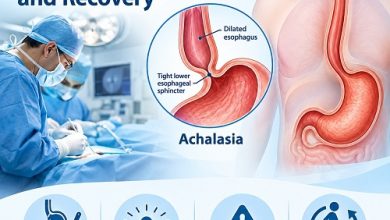
With achalasia, the oesophagus gradually loses its ability to produce normal peristaltic contractions. The LES also fails to relax properly during swallowing.
This combination makes it harder for food and liquid to pass from the oesophagus into the stomach.
Achalasia can develop at any age, although it is most commonly Achalasia diagnosed in adults. Symptoms can develop gradually, which means some people may initially attribute their swallowing problems to eating too quickly, acid reflux or another digestive condition.
Achalasia and Difficulty Swallowing: What Causes the Problem?
The relationship between achalasia and difficulty swallowing becomes clearer when you understand what happens during normal swallowing.
When you swallow:
- Food moves from the mouth into the oesophagus.
- Muscular contractions push the food downward.
- The LES relaxes.
- Food enters the stomach.
- The LES closes again.
In achalasia, the oesophageal muscles do not move food normally, and the LES does not relax sufficiently.
Food can therefore remain in the oesophagus rather than passing efficiently into the stomach.
Over time, retained food and liquid can cause the oesophagus to stretch or enlarge. This may make the swallowing problem progressively more noticeable.
What Is Dysphagia?
Dysphagia means difficulty swallowing. It is one of the most important symptoms of achalasia.
You may experience dysphagia as:
- A sensation that food is stuck
- Difficulty getting food into the stomach
- Food stopping behind the breastbone
- Difficulty swallowing liquids
- Difficulty swallowing solid foods
- Repeated swallowing to clear food
- Taking longer than usual to finish meals
- Drinking water to help food pass
Some people experience difficulty swallowing both solids and liquids from relatively early in the condition.
This can help distinguish achalasia from some other causes of swallowing difficulty, although symptoms alone cannot establish the diagnosis.
Why Can Both Food and Liquids Become Difficult to Swallow?
The swallowing problems caused by achalasia are related to impaired oesophageal movement and LES relaxation rather than simply a physical blockage.
For example, a narrowing caused by a structural problem may initially make solid foods more difficult to swallow because solids have less flexibility to pass through a narrowed area.
Achalasia is different.
Because the oesophagus cannot effectively propel its contents and the LES does not relax normally, both food and liquids may remain in the oesophagus.
This is one reason healthcare professionals consider the pattern of dysphagia when investigating possible achalasia.
How Does Esophageal Motility Affect Swallowing?
Esophageal motility refers to the coordinated muscular activity that moves swallowed material through the oesophagus.
The oesophagus contains layers of muscle that contract in a carefully coordinated sequence. These contractions are essential for moving food towards the stomach.
In achalasia, nerve cells involved in controlling these muscles are damaged or lost. The exact reason this happens is not fully understood.
As nerve function changes, normal peristalsis can become impaired. The LES may also remain tightly closed instead of relaxing appropriately when you swallow.
This creates two major problems:
Poor movement: The oesophagus cannot efficiently push food and liquid downward.
Poor relaxation: The LES does not open normally to allow swallowed material into the stomach.
Together, these abnormalities explain many of the swallowing problems associated with achalasia.
What Happens to Food After You Swallow?
When you have achalasia, swallowed material can collect in the oesophagus.
You may notice a sensation of pressure or fullness behind the breastbone. Some people describe it as though food is sitting in their chest.
Food may eventually pass into the stomach, but it can take considerably longer.
In other cases, food or liquid may come back up into the mouth. This is called regurgitation.
Regurgitation is different from vomiting because it may occur without nausea or forceful abdominal contractions.
Regurgitation and Achalasia
Regurgitation is a common symptom associated with achalasia.
Because food and liquid can remain in the oesophagus, they may move back upwards, particularly when lying down.
You might notice:
- Undigested food coming back into your mouth
- Liquid regurgitation
- Night-time coughing
- A sour or unpleasant taste
- Choking sensations during sleep
- Waking up with fluid or food in the throat
These symptoms can sometimes be mistaken for gastro-oesophageal reflux disease (GORD).
However, achalasia and GORD are different conditions and require different approaches to diagnosis and treatment.
Why Can Achalasia Cause Chest Pain?
Difficulty swallowing is not the only symptom associated with achalasia.
Some people experience chest pain or discomfort, particularly after swallowing.
Several factors may contribute to this sensation, including abnormal oesophageal contractions and pressure caused by retained food or liquid.
Chest discomfort can sometimes be confused with heart-related pain.
Because chest pain has many possible causes, sudden, severe or unexplained chest pain should receive urgent medical assessment rather than being automatically attributed to achalasia.
Does Achalasia Get Worse Over Time?
Symptoms can gradually become more noticeable because food and liquid may repeatedly remain in the oesophagus.
As the condition progresses, the oesophagus can become increasingly dilated in some people.
This may contribute to:
- Increasing dysphagia
- More frequent regurgitation
- Longer mealtimes
- Reduced food intake
- Weight loss
- Coughing
- Chest discomfort
However, symptoms and progression vary considerably between individuals.
Some people experience relatively mild symptoms for a long period, while others develop significant swallowing problems.
Why Might Someone Lose Weight?
Weight loss can occur when achalasia makes eating difficult.
If swallowing becomes uncomfortable or time-consuming, you may naturally eat smaller meals or avoid certain foods.
Regurgitation can also reduce the amount of food that successfully reaches the stomach.
In more advanced cases, persistent swallowing problems may contribute to nutritional deficiencies and significant weight loss.
Unexplained weight loss should always be discussed with a healthcare professional, particularly when it occurs alongside dysphagia.
Can Achalasia Cause Coughing?
Yes. Achalasia may cause coughing because retained food or liquid can move upwards from the oesophagus.
This can be particularly noticeable when lying down.
If material enters the airway, it may cause choking or respiratory symptoms. Repeated aspiration can potentially contribute to lung complications.
Seek medical advice if you regularly experience coughing, choking or breathing difficulties after eating or during sleep.
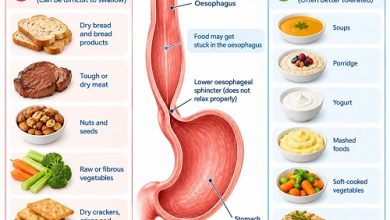
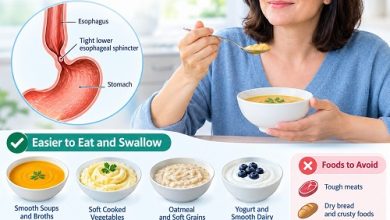
What Foods Can Be Difficult to Swallow?
Food tolerance varies from person to person.
Some people find that dry or dense foods are particularly difficult to swallow, while softer foods and liquids may be easier.
Potentially troublesome foods may include:
- Dry bread
- Tough meat
- Large pieces of food
- Dry crackers
- Raw vegetables
- Nuts
- Very fibrous foods
However, there is no universal achalasia diet that works for everyone.
Eating slowly, chewing food thoroughly and taking small bites may help some people manage symptoms, but these measures do not correct the underlying motility disorder.
Why Do Eating Habits Sometimes Help?
Certain eating habits may make swallowing more manageable because they reduce the amount of food that needs to move through the oesophagus at one time.
You may find it useful to:
- Take small bites
- Chew thoroughly
- Eat slowly
- Remain upright while eating
- Drink fluids according to your healthcare professional’s advice
- Avoid eating immediately before lying down
- Identify foods that consistently trigger symptoms
These strategies can help with symptom management but should not replace medical evaluation or treatment.
How Is Achalasia Diagnosed?
Because several conditions can cause dysphagia, doctors may use multiple tests to determine whether achalasia is responsible.
Upper Endoscopy
An upper endoscopy allows a healthcare professional to examine the oesophagus and stomach using a flexible camera.
It can help identify other causes of swallowing difficulty, including structural abnormalities or inflammation.
Barium Swallow
During a barium swallow study, you drink a contrast liquid while X-ray images are taken.
The test can show how material moves through the oesophagus and may reveal characteristic changes associated with achalasia.
Oesophageal Manometry
Oesophageal manometry is particularly important for assessing esophageal motility.
A thin tube measures pressure and muscle activity in the oesophagus while you swallow.
This test can identify abnormal oesophageal contractions and impaired relaxation of the LES.
Different patterns of muscle activity can also help doctors classify achalasia into different subtypes.
Are There Different Types of Achalasia?
Doctors generally describe three major subtypes based on findings from high-resolution manometry:
- Type I achalasia
- Type II achalasia
- Type III achalasia
These types reflect different patterns of oesophageal muscle activity.
Type I involves minimal oesophageal pressurisation and absent normal peristalsis.
Type II involves increased pressure throughout the oesophagus during swallowing.
Type III involves abnormal or premature contractions of the oesophageal muscles.
The subtype can help healthcare professionals understand the pattern of esophageal motility and determine which treatment approaches may be appropriate.
What Conditions Can Cause Similar Swallowing Problems?
Not every case of dysphagia is caused by achalasia.
Other possible Achalasia Causes include:
- GORD
- Oesophageal strictures
- Eosinophilic oesophagitis
- Oesophageal cancer
- Certain neurological disorders
- Other oesophageal motility disorders
- Structural abnormalities
This is why persistent swallowing difficulty should not be self-diagnosed.
A healthcare professional can determine which investigations are appropriate based on your symptoms and medical history.
How Is Achalasia Treated?
Treatment aims to reduce resistance at the LES and help food pass more easily into the stomach.
Achalasia Treatment options may include:
Pneumatic Dilatation
Pneumatic dilatation uses a specialised balloon to stretch the LES.
The procedure aims to reduce the pressure of the muscle and improve passage of food into the stomach.
Laparoscopic Heller Myotomy
Heller myotomy involves cutting selected muscle fibres of the LES to reduce resistance.
It is usually performed using minimally invasive surgical techniques.
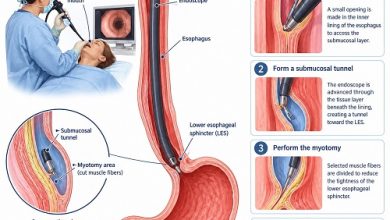
Peroral Endoscopic Myotomy
Peroral endoscopic myotomy, commonly called POEM, uses an endoscope to access and divide muscle fibres in the oesophageal wall.
It is an endoscopic treatment that can improve the passage of food through the LES.
Botulinum Toxin
Botulinum toxin can be injected into the LES to temporarily reduce muscle activity.
Its effects are generally temporary, so it may be considered in selected patients, particularly when other procedures are not appropriate.
Achalasia Treatment Options
Achalasia is a rare swallowing disorder in which the lower oesophageal sphincter does not relax properly, making it difficult for food and liquids to pass into the stomach. Achalasia treatment options focus on improving swallowing, reducing symptoms and helping food move more easily through the oesophagus.
Medical treatment may include prescription medicines or injections that temporarily relax the lower oesophageal sphincter. Some people may benefit from pneumatic dilation, a procedure that stretches the sphincter. Surgical treatment, such as Heller myotomy, can provide longer-lasting symptom relief. Peroral endoscopic myotomy (POEM) is another minimally invasive procedure that cuts selected muscle fibres to improve the passage of food.
Some people also search for a Natural Cure for Achalasia. Lifestyle measures cannot remove the underlying muscle or nerve problem, but certain habits may help with symptom management. Eating slowly, choosing softer foods, taking smaller meals and remaining upright after eating may make swallowing more comfortable. Maintaining adequate hydration is also important.
Because achalasia can cause food retention, weight loss and nutritional problems, professional medical assessment is important. Discuss symptoms and treatment choices with a gastroenterologist before using supplements or complementary approaches. A personalised treatment plan can depend on symptom severity, age, overall health and previous treatments.
Can Medicines Cure Achalasia?
Medicines may sometimes provide temporary symptom relief by reducing LES pressure, but they generally do not correct the underlying problem as effectively as definitive procedures.
Your gastroenterologist can explain whether medication has a role in your particular situation.
Avoid starting medicines or supplements specifically for achalasia without discussing them with a qualified healthcare professional.
When Should You See a Doctor?
Persistent or progressive swallowing difficulty deserves medical evaluation.
Speak with a healthcare professional if you regularly experience:
- Difficulty swallowing food or liquids
- Food becoming stuck
- Regurgitation
- Unexplained weight loss
- Chest discomfort after swallowing
- Night-time coughing or choking
- Increasing difficulty eating
Seek urgent medical care if you cannot swallow liquids or saliva, have severe chest pain, significant breathing difficulty or other potentially serious symptoms.
Living With Achalasia and Difficulty Swallowing
Living with achalasia and difficulty swallowing can affect eating, social activities and overall quality of life.
However, recognising the symptoms and obtaining an accurate diagnosis can make it easier to manage the condition.
Keep track of symptoms such as when dysphagia occurs, which foods cause problems, whether liquids are affected and whether regurgitation occurs.
This information can help your healthcare professional understand your symptoms.
It is also important to follow the treatment plan recommended by your gastroenterology team and attend follow-up appointments.
Final Thoughts
Achalasia and difficulty swallowing are closely linked because achalasia disrupts the normal movement of food through the oesophagus. Damage to the nerves controlling oesophageal muscles can interfere with peristalsis and prevent the LES from relaxing normally.
This can lead to dysphagia, regurgitation, chest discomfort, coughing and other swallowing problems.
Because several other conditions can cause similar symptoms, persistent dysphagia requires proper medical assessment. Tests such as endoscopy, barium swallow and oesophageal manometry can help identify the cause.
Although lifestyle and eating strategies may help manage symptoms, achalasia often requires medical or procedural treatment to improve the passage of food into the stomach.
Medical Disclaimer
This article is for educational purposes only and does not replace professional medical advice, diagnosis or treatment. If you have persistent difficulty swallowing, regurgitation, unexplained weight loss, chest pain or choking, consult a qualified healthcare professional. Seek urgent medical attention for severe or sudden symptoms.