
Achalasia is an uncommon disorder of the oesophagus that can make swallowing increasingly difficult. People with this condition may feel as though food or liquid becomes stuck in the chest, experience regurgitation, or develop discomfort after eating. Understanding achalasia causes can help explain why normal swallowing becomes disrupted and why certain symptoms develop.
The exact cause of achalasia remains unclear. However, researchers believe that damage to the nerves controlling the oesophagus plays an important role. This nerve dysfunction can affect the muscles responsible for moving food towards the stomach and can interfere with the normal relaxation of the lower oesophageal sphincter.
Several factors have been investigated in relation to achalasia, including autoimmune processes, infections, genetic susceptibility and other conditions affecting the nervous system. However, having a potential risk factor does not necessarily mean that a person will develop achalasia.
What Is Achalasia?
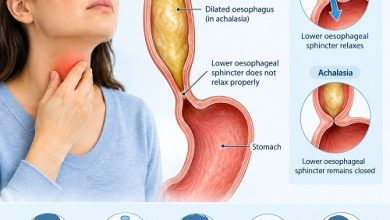
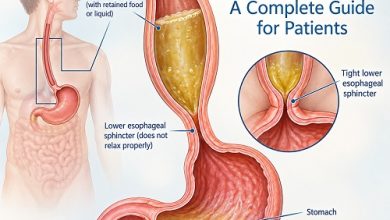
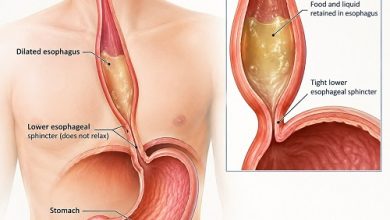
What Is Achalasia? Achalasia is a disorder in which the oesophagus has difficulty moving food and liquids into the stomach. The oesophagus is a muscular tube that connects the throat to the stomach. During normal swallowing, coordinated muscle contractions move food downwards while the lower oesophageal sphincter relaxes to allow food to enter the stomach.
With achalasia, these processes become impaired.
The lower oesophageal sphincter may remain too tight instead of relaxing properly. At the same time, the normal muscular contractions of the oesophagus can become weak or uncoordinated. As a result, food and liquids may remain in the oesophagus for longer than expected.
These changes can contribute to several esophagus problems, including swallowing difficulties, regurgitation and chest discomfort.
Understanding Achalasia Causes
The precise achalasia causes are still being investigated. Unlike some digestive disorders, achalasia usually cannot be linked to one simple lifestyle factor or a single identifiable event.
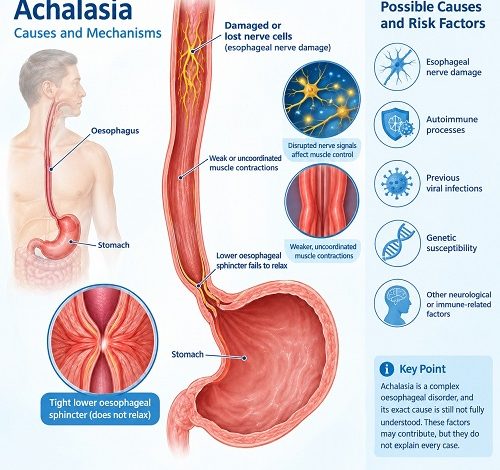
One of the most important findings involves the loss or dysfunction of nerve cells within the oesophageal wall. These nerves help coordinate the muscle activity required for normal swallowing.
When these nerve cells become damaged, the oesophagus may gradually lose its ability to move food efficiently.
Researchers have proposed several possible explanations for this nerve dysfunction. These include autoimmune reactions, viral infections and genetic factors. However, evidence varies between individuals, and no single explanation accounts for every case.
Esophageal Nerve Damage and Achalasia
Esophageal nerve damage is one of the central areas of research into achalasia.
The oesophagus contains a network of nerves that controls its muscular movements. These nerves communicate with the muscles and help coordinate the movement of swallowed food.
Certain nerve cells are particularly important because they help regulate relaxation of the lower oesophageal sphincter. If these nerve cells are lost or damaged, the sphincter may fail to relax normally during swallowing.
This can result in food and liquid accumulating in the oesophagus.
Over time, the oesophagus may become enlarged because it repeatedly holds food and fluids. Some people may experience worsening swallowing problems as these changes progress.
The relationship between esophageal nerve damage and achalasia is therefore an important part of understanding the condition, although researchers are still investigating what initially triggers the nerve damage.
Could an Autoimmune Reaction Be Involved?
An autoimmune process is one possible explanation for some cases of achalasia.
The immune system normally protects the body from harmful organisms and other threats. In an autoimmune disorder, the immune system mistakenly reacts against the body’s own tissues.
Researchers have found evidence suggesting that immune activity may contribute to damage of the nerve cells involved in oesophageal function in some people with achalasia.
However, this does not mean that achalasia is simply an autoimmune disease. The evidence is still developing, and researchers continue to investigate how immune responses might interact with other potential causes.
Could Viral Infections Play a Role?
Viral infections have also been investigated as a possible trigger for achalasia.
Some researchers have proposed that a viral infection could potentially trigger an immune response that damages nerve cells in the oesophagus. Viruses such as herpes-family viruses have been investigated in research into possible mechanisms.
However, the presence of a previous viral infection does not establish that the infection caused achalasia.
There is currently no simple test that can identify a particular viral infection as the cause of an individual’s achalasia. More research is needed to determine whether infections directly contribute to the development of the condition.
Genetic Factors and Achalasia
Genetic susceptibility may be another factor in some cases.
Most people diagnosed with achalasia do not have a clear family history of the condition. However, rare familial cases have been reported, suggesting that genetic factors may contribute in certain circumstances.
Researchers have also investigated associations between achalasia and particular genetic or immune-related characteristics.
A family history alone does not mean that someone will develop achalasia. The condition is relatively uncommon, and the majority of cases occur without an obvious inherited pattern.
Age and Achalasia Risk Factors
Achalasia can occur at different ages, including childhood and adulthood. It is most frequently diagnosed in adults, although children can also develop the condition.
Age by itself is therefore not a direct cause of achalasia.
Some people may have subtle symptoms for a long period before receiving a diagnosis. This can make it difficult to determine exactly when the underlying oesophageal changes began.
Because swallowing difficulties can have many causes, persistent symptoms deserve appropriate medical assessment rather than being automatically attributed to ageing or another digestive problem.
Are There Lifestyle-Related Achalasia Risk Factors?
Unlike many common digestive conditions, achalasia has not been clearly linked to a specific diet, exercise pattern or everyday lifestyle habit.
There is no established evidence that eating spicy foods, drinking coffee, consuming particular foods or having a sedentary lifestyle directly causes achalasia.
However, lifestyle factors can influence how comfortable a person feels while living with swallowing difficulties.
For example, some people may find that eating slowly, taking smaller bites and drinking fluids with meals makes swallowing more manageable. These measures may help with symptom management but do not address the underlying nerve and muscle dysfunction.
It is important to distinguish between factors that may influence symptoms and genuine achalasia risk factors.
Achalasia and Other Oesophagus Problems
Achalasia shares symptoms with several other conditions affecting the oesophagus. Difficulty swallowing, chest discomfort and regurgitation can occur with different digestive disorders.
Examples of oesophageal problems include:
- Gastro-oesophageal reflux disease
- Oesophageal strictures
- Oesophageal motility disorders
- Oesophageal inflammation
- Certain structural abnormalities
- Oesophageal tumours
This overlap can sometimes make achalasia difficult to identify based on symptoms alone.
A healthcare professional may recommend tests such as oesophageal manometry, an upper endoscopy or a barium swallow study to investigate swallowing problems and determine whether achalasia is present.
Is Stress a Cause of Achalasia?
Stress can affect digestion and may make some gastrointestinal symptoms feel worse. However, stress has not been established as a direct cause of achalasia.
A person may notice more discomfort during periods of stress because changes in eating habits, muscle tension or awareness of symptoms can influence how digestive symptoms are perceived.
The underlying changes associated with achalasia involve the nerves and muscles of the oesophagus. Therefore, managing stress may support general wellbeing but should not be considered a treatment for the underlying condition.
Can Food Cause Achalasia?
There is no recognised food that directly causes achalasia.
People sometimes associate the onset of swallowing difficulties with a particular meal or type of food because symptoms become noticeable while eating. However, the food itself is generally not considered the underlying cause.
Certain foods may be easier or more difficult to swallow once achalasia has developed. Dry, dense or poorly chewed foods may feel particularly difficult for some individuals.
Keeping a food and symptom diary can sometimes help a person identify foods that are personally difficult to tolerate. A healthcare professional or dietitian can provide further guidance where necessary.
Can Previous Surgery Cause Achalasia?
Surgery involving the oesophagus or nearby structures can affect swallowing in some circumstances, but this does not mean that previous surgery is a typical cause of primary achalasia.
Doctors distinguish achalasia from conditions that can produce similar symptoms because of another underlying cause.
A condition that resembles achalasia because of a blockage or another structural problem may sometimes be referred to as pseudoachalasia.
This distinction is important because the appropriate investigation and treatment can differ.
What Is Pseudoachalasia?
Pseudoachalasia refers to symptoms or test findings that resemble achalasia but result from another underlying condition.
In some cases, a tumour near the junction between the oesophagus and stomach can interfere with normal passage of food and produce symptoms similar to achalasia.
Pseudoachalasia is uncommon, but healthcare professionals consider it when certain features are present, such as rapid development of severe swallowing difficulties or significant unexplained weight loss.
This is one reason why appropriate medical investigation is important when symptoms persist or become progressively worse.
Common Symptoms Associated With Achalasia
Although the causes of achalasia remain uncertain, its symptoms can be easier to recognise.
Common symptoms include:
- Difficulty swallowing food or liquids
- Regurgitation of undigested food
- Chest discomfort
- A sensation that food is stuck behind the breastbone
- Coughing, particularly at night
- Unintentional weight loss
- Difficulty eating normal meals
- Heartburn-like symptoms
- Changes in eating habits
Symptoms can develop gradually. Some people initially have occasional swallowing difficulties and may only seek medical advice when the problem becomes more frequent.
When Should You Speak to a Doctor?
Persistent swallowing difficulties should receive medical attention.
You should consider speaking with a healthcare professional if you regularly experience difficulty swallowing food or liquids, repeated regurgitation, unexplained weight loss or persistent chest discomfort associated with eating.
Seek urgent medical care if you are unable to swallow liquids, have severe chest pain, experience breathing difficulties or believe food is completely stuck.
These symptoms can have several possible causes, so professional assessment is important.
How Is Achalasia Diagnosed?
Doctors may use several investigations to determine whether achalasia is responsible for swallowing problems.
Oesophageal Manometry
Oesophageal manometry measures pressure and muscle activity within the oesophagus. It can help determine whether the lower oesophageal sphincter relaxes correctly and whether normal oesophageal contractions are present.
Upper Endoscopy
An upper endoscopy allows a healthcare professional to examine the oesophagus and stomach using a flexible camera. It can help identify other causes of swallowing difficulties and rule out structural abnormalities.
Barium Swallow
During a barium swallow test, a person drinks a contrast liquid while X-ray images are taken. The test can show how the liquid passes through the oesophagus and may reveal characteristic changes associated with achalasia.
These investigations help distinguish achalasia from other esophagus problems that can cause similar symptoms.
Does Knowing the Cause Change Treatment?
Identifying the precise trigger behind an individual’s achalasia is difficult because the underlying cause often remains unknown.
Achalasia Treatment therefore generally focuses on improving the movement of food from the oesophagus into the stomach and reducing symptoms.
Depending on the individual’s circumstances, healthcare professionals may consider treatments such as pneumatic dilation, surgical myotomy, peroral endoscopic myotomy or botulinum toxin injection.
The appropriate approach depends on factors such as age, overall health, achalasia type, symptom severity and medical history.
Treatment decisions should be made with a qualified healthcare professional.
Can Achalasia Be Prevented?
Because the exact achalasia causes remain uncertain, there is currently no established way to prevent most cases.
There is no proven diet, supplement or lifestyle routine that can guarantee prevention of achalasia.
However, recognising persistent swallowing difficulties early can help people receive appropriate assessment sooner. Early investigation can also help distinguish achalasia from other conditions that may require different treatment.
Key Takeaways About Achalasia Causes
The exact achalasia causes are still not fully understood. Research suggests that dysfunction or loss of nerve cells in the oesophageal wall plays a major role. This can interfere with normal muscle contractions and prevent the lower oesophageal sphincter from relaxing properly.
Potential factors investigated by researchers include:
- Esophageal nerve damage
- Autoimmune processes
- Previous infections
- Genetic susceptibility
- Other neurological or immune-related factors
However, these factors should not be treated as confirmed causes for every person with achalasia.
The most important point is that achalasia is a complex oesophageal disorder rather than a condition caused by one specific food or lifestyle habit. Persistent swallowing difficulties, regurgitation or unexplained weight loss should be assessed by a healthcare professional.
Understanding achalasia risk factors and recognising the symptoms can encourage timely medical evaluation. With appropriate diagnosis and treatment, healthcare professionals can help manage the swallowing difficulties associated with this condition and improve day-to-day quality of life.
Medical Disclaimer
This article is for educational purposes only and does not provide medical diagnosis, treatment or professional medical advice. Achalasia and persistent swallowing difficulties require assessment by a qualified healthcare professional. Do not delay medical care or change prescribed treatment based on information in this article.