

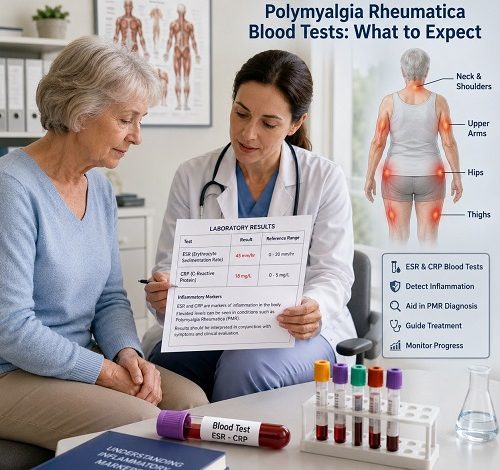
Polymyalgia rheumatica (PMR) can cause significant pain and stiffness, particularly around the shoulders, neck, hips, and upper thighs. Because its Polymyalgia Rheumatica symptoms can resemble those of rheumatoid arthritis, thyroid disorders, muscle diseases, infections, and other conditions, diagnosing PMR usually involves more than one test.
Polymyalgia Rheumatica Blood Tests are an important part of this process. Doctors commonly check blood tests that look for inflammation, particularly the erythrocyte sedimentation rate (ESR) and C-reactive protein (CRP). However, these tests do not diagnose PMR by themselves. Instead, they provide evidence that inflammation may be occurring and help doctors evaluate whether the overall picture fits PMR.
What Is Polymyalgia Rheumatica?
What Is Polymyalgia Rheumatica? Polymyalgia rheumatica is an inflammatory condition that primarily affects adults over age 50. It commonly causes pain and stiffness around both shoulders and the hips, with symptoms often being particularly troublesome in the morning. The neck, upper arms, buttocks, and thighs can also be affected.
The condition is different from ordinary muscle soreness. Morning stiffness may last for a considerable period and can make everyday activities such as getting dressed, getting out of bed, or raising the arms difficult.
There is no single laboratory test that proves a person has PMR. Doctors generally combine:
- Symptoms and medical history
- Physical examination
- Blood tests
- Tests used to exclude other conditions
- Sometimes ultrasound or other imaging
- Response to appropriate treatment
This is why blood test for PMR is best understood as part of a broader diagnostic evaluation rather than a standalone test.
Why Are Blood Tests Used for PMR?
One of the main characteristics of PMR is inflammation. Blood tests can provide evidence of this inflammatory activity.
The two most commonly discussed inflammatory markers are:
- ESR — erythrocyte sedimentation rate
- CRP — C-reactive protein
Both can become elevated when inflammation is present. However, neither marker is specific to PMR. Infections, autoimmune diseases, some cancers, injuries, and other inflammatory conditions can also affect ESR and CRP.
For this reason, an elevated result does not automatically mean that someone has polymyalgia rheumatica.
Instead, doctors consider the result alongside symptoms, examination findings, age, duration of symptoms, and other laboratory investigations.
ESR for PMR: What Does It Measure?
ESR for PMR refers to the erythrocyte sedimentation rate test.
ESR measures how quickly red blood cells settle toward the bottom of a tube during a specified period. Inflammatory changes in the blood can cause red blood cells to settle more quickly, resulting in a higher ESR.
In people with PMR, ESR is often elevated because the condition involves systemic inflammation.
However, there is no single ESR number that confirms PMR.
The result can vary depending on factors such as age, sex, other medical conditions, and the laboratory’s reference range. Therefore, your doctor will interpret your ESR according to your individual situation rather than relying on one universal cutoff.
What does a high ESR mean?
A high ESR suggests that inflammation may be present somewhere in the body. It does not identify the exact cause.
For example, an elevated ESR may occur with:
- PMR
- Rheumatoid arthritis
- Infections
- Other inflammatory disorders
- Certain autoimmune conditions
- Some cancers
- Other medical conditions
Therefore, a high ESR supports the possibility of PMR when the symptoms and examination are also consistent with the disease, but it does not establish the diagnosis by itself.
CRP for PMR: What Does It Show?
CRP for PMR refers to a blood test measuring C-reactive protein.
CRP is produced by the liver and can increase when inflammation is occurring in the body. It is another commonly used marker when doctors are evaluating suspected PMR.
CRP can change relatively quickly as inflammation increases or decreases. This makes it useful not only during the initial evaluation but also during follow-up in some patients.
A raised CRP can support a diagnosis of PMR when the patient’s symptoms are typical.
However, just like ESR, CRP is not specific to PMR.
A high CRP can occur with many different inflammatory or infectious conditions, so doctors must interpret the result in context.
ESR vs. CRP for PMR
Doctors often order ESR and CRP together rather than relying on only one inflammatory marker.
This is useful because the two tests measure inflammation in somewhat different ways and can provide complementary information.
For example, the NHS notes that sometimes ESR can be normal while CRP is raised, which is one reason both tests are commonly performed.
A typical evaluation may therefore look something like this:
| Test | What it measures | Why it may be used |
| ESR | Rate at which red blood cells settle | Helps identify inflammatory activity |
| CRP | C-reactive protein in blood | Detects systemic inflammation |
| CBC | Blood cell counts | Helps identify anemia, infection, or other abnormalities |
| RF | Rheumatoid factor | Helps evaluate for rheumatoid arthritis |
| Anti-CCP | Specific antibodies | Helps evaluate for rheumatoid arthritis |
| TSH | Thyroid function | Helps investigate thyroid-related symptoms |
| CK | Muscle enzyme | May help evaluate muscle disorders |
Not every person needs every test. Your healthcare professional decides which investigations are appropriate based on your Polymyalgia Rheumatica symptoms and examination.
What Other Blood Tests Might Be Ordered?
Although ESR and CRP receive most of the attention, a doctor may order additional tests when PMR is suspected.
The purpose is often to rule out other explanations for pain and stiffness.
Complete Blood Count
A complete blood count (CBC) measures different types of blood cells.
It may provide information about anemia, infection, or other abnormalities. A CBC can therefore contribute to the overall evaluation but does not specifically diagnose PMR.
Rheumatoid Factor
Rheumatoid factor (RF) may be checked when rheumatoid arthritis is a possibility.
PMR and rheumatoid arthritis can produce overlapping symptoms, particularly in older adults. RF testing can help doctors evaluate whether another inflammatory condition may be responsible.
Anti-CCP Antibodies
Anti-cyclic citrullinated peptide (anti-CCP) antibodies may also be tested when rheumatoid arthritis is suspected.
These tests are generally used to help distinguish PMR from rheumatoid arthritis rather than to diagnose PMR itself.
Thyroid Tests
Thyroid disorders can sometimes cause muscle aches, weakness, fatigue, or other symptoms that may overlap with PMR.
A thyroid-stimulating hormone (TSH) test may therefore be considered when appropriate.
Creatine Kinase
Creatine kinase (CK) may be considered when a muscle disorder is part of the differential diagnosis.
The choice of additional tests depends on the patient’s symptoms and the doctor’s clinical assessment.
What Happens During a PMR Blood Test?
The actual blood draw is usually straightforward.
A healthcare professional typically:
- Cleans the skin on your arm.
- Inserts a small needle into a vein.
- Collects one or more tubes of blood.
- Removes the needle.
- Applies pressure or a small dressing.
- Sends the sample to a laboratory.
The blood draw itself generally takes only a few minutes. Mayo Clinic notes that ESR testing does not normally require fasting.
If your doctor has ordered several blood tests, multiple tubes may be collected during the same appointment.
You may experience minor tenderness or bruising afterward, but most people can return to normal activities.
Do You Need to Fast Before Polymyalgia Rheumatica Blood Tests?
ESR itself generally does not require fasting.
However, your doctor may order other blood tests at the same appointment that have different preparation requirements.
For example, depending on what else is being evaluated, you may be given specific instructions about food, medication, or the timing of the blood draw.
The safest approach is to follow the instructions provided by your healthcare professional or laboratory rather than assuming that every blood test has identical preparation requirements.
What Do High ESR and CRP Results Mean?
If both ESR and CRP are elevated, this can provide evidence of significant inflammatory activity.
When a person also has typical PMR symptoms—such as new shoulder and hip pain, prolonged morning stiffness, and difficulty with movement—the findings may strengthen the suspicion of PMR.
However, high inflammatory markers do not prove PMR.
This distinction is important.
ESR and CRP are nonspecific. Many diseases can cause inflammation and increase these markers. The NHS specifically emphasizes that high levels do not automatically mean a person has PMR.
Your doctor may therefore investigate other possibilities before confirming the diagnosis.
Can PMR Have Normal Blood Tests?
This is one of the most important questions about Polymyalgia Rheumatica Blood Tests.
Most people with PMR have evidence of inflammation, but laboratory results do not always follow a simple pattern.
Mayo Clinic notes that not everyone with PMR has high ESR or CRP levels.
The NHS states that when both ESR and CRP are normal, PMR is unlikely, while an isolated normal ESR with an elevated CRP can occur.
This means doctors should not interpret one laboratory result in isolation.
If symptoms strongly suggest PMR but the blood tests are unusual, the clinician may reassess the diagnosis and consider other Polymyalgia Rheumatica causes. Additional testing or imaging may sometimes be appropriate.
Can Blood Tests Confirm PMR?
No single blood test for PMR can definitively confirm the disease.
This is because there is no specific laboratory marker unique to polymyalgia rheumatica.
Instead, doctors usually look for a pattern:
- Appropriate age
- Typical shoulder and/or hip symptoms
- Significant morning stiffness
- Symptoms lasting long enough to fit the clinical picture
- Evidence of inflammation
- No better alternative explanation
- Appropriate response to treatment
The NHS describes Polymyalgia Rheumatica diagnosis as a process involving several different tests because symptoms overlap with other diseases.
This approach helps prevent other potentially important conditions from being overlooked.
Are Imaging Tests Needed?
Blood tests are important, but they are not always the entire diagnostic process.
Ultrasound can sometimes identify inflammation around the shoulders and hips and may support the diagnosis in appropriate cases. Mayo Clinic also notes that MRI or PET scanning may be considered in selected circumstances to investigate other causes of symptoms.
Imaging is not necessarily required for every person with suspected PMR.
Your doctor may recommend it if:
- The diagnosis is uncertain.
- Symptoms are unusual.
- Another condition needs to be excluded.
- Blood test findings do not fit the clinical picture.
- There is concern about another musculoskeletal problem.
Why Doctors Look for Giant Cell Arteritis
PMR has an important association with another inflammatory condition called giant cell arteritis (GCA).
During a PMR evaluation, doctors may ask about symptoms that could suggest GCA.
These include:
- A new or persistent headache
- Jaw pain when chewing
- Scalp tenderness
- Blurred or double vision
- Vision loss
These symptoms require prompt medical assessment because giant cell arteritis can affect blood vessels supplying the eyes and other tissues.
If such symptoms occur, do not wait for a routine PMR follow-up appointment. Seek urgent medical evaluation.
Do PMR Blood Tests Change During Treatment?
ESR and CRP can be useful during follow-up because inflammatory activity may decrease when Polymyalgia Rheumatica treatment is effective.
Doctors may combine changes in laboratory markers with your symptoms and physical function to assess how well treatment is working.
However, blood results should not be viewed in isolation.
A person may feel better before laboratory values completely normalize, or symptoms may return for reasons that require further assessment.
Your healthcare professional will determine how frequently testing is appropriate.
What Should You Ask Your Doctor About Your Results?
If you have had Polymyalgia Rheumatica Blood Tests, consider asking:
- What were my ESR and CRP levels?
- Are my inflammatory markers elevated?
- What reference range does this laboratory use?
- Could another condition explain the results?
- Do I need rheumatoid factor or anti-CCP testing?
- Should my thyroid function be checked?
- Do I need additional blood tests?
- Is imaging necessary?
- Should I be evaluated for symptoms of giant cell arteritis?
- When should my blood tests be repeated?
Understanding the reason behind each test can make the diagnostic process easier to follow.
What to Expect After Your Blood Test
Getting an abnormal result does not necessarily mean you have PMR.
Similarly, a result that is not dramatically elevated does not automatically rule out every possibility.
The most useful interpretation comes from putting the laboratory findings together with:
Symptoms + physical examination + blood tests + exclusion of other diseases + clinical follow-up
This is especially important because PMR symptoms overlap with several other conditions.
A careful diagnosis helps ensure that appropriate treatment is provided and that other diseases are not missed.
When Should You Seek Medical Advice?
If you are over 50 and develop new, persistent pain and stiffness around your shoulders, hips, or neck—especially if morning stiffness lasts a long time—it is worth discussing your symptoms with a healthcare professional.
You should seek prompt medical attention if these symptoms occur together with possible giant cell arteritis symptoms such as a new severe headache, jaw pain while chewing, scalp tenderness, blurred or double vision, or vision loss.
Early assessment is important because PMR is treatable, while some alternative diagnoses require different management.
Final Thoughts on Polymyalgia Rheumatica Blood Tests
Polymyalgia Rheumatica Blood Tests are an important part of evaluating suspected PMR, but there is no single blood test that proves the diagnosis.
The two most important inflammatory markers are usually ESR and CRP. Both can become elevated when inflammation is present and can support a diagnosis when they match the patient’s symptoms and examination.
Doctors may also order additional tests—including a complete blood count, rheumatoid factor, anti-CCP antibodies, thyroid testing, or other investigations—to rule out conditions that can look similar to PMR.
The key takeaway is simple: ESR and CRP provide clues, not a definitive diagnosis. Your healthcare professional must interpret your blood test results together with your symptoms, examination, medical history, and other investigations.
If you have symptoms suggestive of PMR, discussing them with a qualified healthcare professional is the best way to determine which tests you need and what your results mean.
This article is for educational purposes and should not replace professional medical diagnosis or treatment.