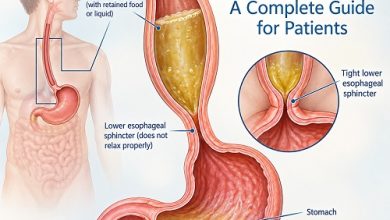

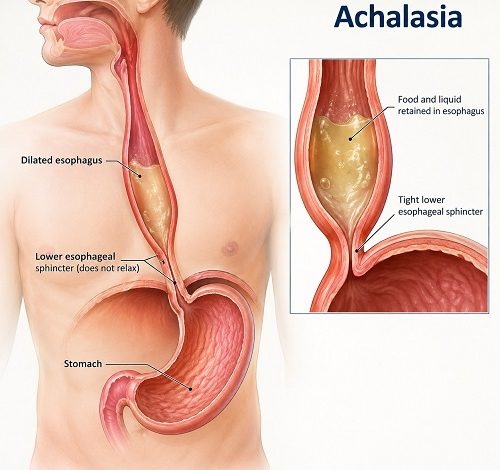
Achalasia is a rare disorder that affects the esophagus, the muscular tube that carries food and liquids from the mouth to the stomach. In people with achalasia, the esophagus has difficulty moving food downward, and the lower esophageal sphincter—the muscular valve between the esophagus and stomach—does not relax normally during swallowing.
As a result, food and liquid can remain in the esophagus instead of passing easily into the stomach. Over time, this can lead to swallowing difficulties, regurgitation, chest discomfort, weight loss, and enlargement of the esophagus.
Understanding Achalasia, including its causes, symptoms, diagnosis, treatment, and long-term management, can help people recognize persistent swallowing problems and seek appropriate medical evaluation.
What Is Achalasia?
Achalasia is an esophageal motility disorder. Normally, coordinated muscle contractions called peristalsis move swallowed food through the esophagus. At the same time, the lower esophageal sphincter relaxes to allow food to enter the stomach.
With achalasia, two important problems occur:
- Normal esophageal peristalsis is impaired or absent.
- The lower esophageal sphincter does not relax properly.
This causes food and liquid to accumulate within the esophagus. Achalasia is considered a chronic condition, and current treatments focus on improving the passage of food through the lower esophageal sphincter and relieving symptoms rather than permanently restoring normal esophageal function.
Achalasia is uncommon, but it can significantly affect nutrition, daily activities, and quality of life when symptoms are not treated.
Achalasia Causes
The exact achalasia causes are not completely understood. Research suggests that the condition involves damage or loss of certain nerve cells within the muscular wall of the esophagus.
These nerve cells normally help coordinate swallowing and relaxation of the lower esophageal sphincter. When inhibitory nerve signaling is disrupted, the sphincter can remain abnormally tight while normal esophageal contractions become impaired.
The American College of Gastroenterology notes that selective loss of inhibitory neurons in the esophageal myenteric plexus is believed to contribute to the disorder. However, why this nerve damage occurs in most people remains uncertain.
Achalasia should not simply be attributed to eating habits or lifestyle. It is a medical disorder involving the function of the esophagus.
Is Achalasia Hereditary?
Most cases of achalasia are not clearly linked to a family history. Although researchers continue to investigate genetic and immune-related factors, there is no single established inherited cause responsible for most cases.
Some conditions can produce symptoms that resemble achalasia. This is one reason accurate testing is important before treatment begins.
Achalasia Symptoms
The achalasia symptoms can develop gradually, and some people may initially mistake them for indigestion, acid reflux, or another digestive problem.
Common symptoms include:
Difficulty Swallowing
Difficulty swallowing, known as dysphagia, is one of the most characteristic symptoms. People may have trouble swallowing both solid foods and liquids.
Unlike some structural problems that initially affect solid foods more than liquids, achalasia can interfere with the passage of both.
Regurgitation
Food, saliva, or liquid can remain in the esophagus and later return to the mouth. Regurgitation may occur after eating or when lying down.
This can sometimes be confused with vomiting, although regurgitation does not necessarily involve the forceful stomach contractions associated with vomiting.
Chest Pain or Discomfort
Some people experience chest pain, pressure, or discomfort. Symptoms may occur during or after swallowing and can vary considerably between individuals.
Because chest pain can have many causes, new or severe chest pain should not automatically be assumed to be caused by achalasia.
Weight Loss
Difficulty eating and impaired passage of food can result in reduced food intake and unintended weight loss.
Significant or unexplained weight loss deserves medical evaluation, particularly when it occurs together with progressive swallowing difficulties.
Heartburn-Like Symptoms
Some people with achalasia experience heartburn or burning sensations. This can sometimes result in an initial diagnosis of gastroesophageal reflux disease (GERD).
The ACG notes that heartburn occurs in a substantial proportion of people with achalasia, meaning persistent symptoms that do not respond as expected to acid-suppressing treatment may require further evaluation.
Coughing or Breathing Problems
Retained food or liquid can sometimes move back toward the throat, particularly when lying down. This may contribute to coughing or other respiratory symptoms.
For this reason, persistent nighttime coughing accompanied by swallowing difficulties should be discussed with a healthcare professional.
When Should You See a Doctor?
Occasional difficulty swallowing may have many causes, but persistent or progressively worsening dysphagia should be evaluated.
Medical assessment is particularly important when swallowing problems occur with:
- Unexplained weight loss
- Frequent regurgitation
- Recurrent chest discomfort
- Coughing after eating
- Difficulty swallowing both food and liquids
- Symptoms that are becoming progressively worse
- Persistent symptoms despite treatment for presumed acid reflux
Early evaluation can help distinguish achalasia from other esophageal conditions.
Achalasia Diagnosis
An accurate achalasia diagnosis generally involves a combination of medical history, endoscopy, imaging, and esophageal function testing.
Three commonly used diagnostic tools are upper endoscopy, barium esophagram, and esophageal manometry.
Upper Endoscopy
During an upper endoscopy, a flexible tube with a camera is passed through the mouth to examine the esophagus and stomach.
Endoscopy can help doctors:
- Look for retained food or saliva
- Examine the lower esophageal sphincter
- Identify inflammation or structural abnormalities
- Exclude tumors, strictures, or other causes of swallowing difficulty
- Help rule out conditions that can mimic achalasia
Endoscopy is especially important because mechanical obstruction can sometimes produce symptoms resembling achalasia.
Barium Esophagram
A barium esophagram involves swallowing a liquid containing barium while X-ray images are taken.
In achalasia, the esophagus may appear enlarged, and the lower end may narrow in a characteristic pattern often described as a “bird-beak” appearance.
A timed barium esophagram can also measure how quickly swallowed material moves through the esophagus.
Esophageal Manometry
High-resolution esophageal manometry is considered the key test for confirming achalasia.
During the test, a thin pressure-sensitive tube is passed through the nose into the esophagus. It measures muscle contractions and pressure changes while the person swallows.
Manometry can identify impaired relaxation of the lower esophageal sphincter and abnormal esophageal movement.
It can also classify achalasia into three major types.
The Three Types of Achalasia
High-resolution manometry helps classify achalasia into:
Type I Achalasia
Type I involves absent normal peristalsis without significant pressurization of the esophageal body.
Type II Achalasia
Type II involves absent normal peristalsis combined with increased pressure throughout the esophagus during swallowing.
Type III Achalasia
Type III is characterized by abnormal or spastic contractions of the esophageal muscles.
The type of achalasia can be relevant when doctors discuss treatment options.
Achalasia Treatment
There is currently no treatment that simply restores normal nerve function in the esophagus. Instead, achalasia treatment aims to reduce the resistance at the lower esophageal sphincter, improve esophageal emptying, and relieve symptoms.
Treatment is individualized according to factors such as achalasia type, age, overall health, previous treatments, anatomy, and available specialist expertise.
Major treatment options include pneumatic dilation, surgical myotomy, peroral endoscopic myotomy, botulinum toxin injection, and selected medications.
Pneumatic Dilation
Pneumatic dilation uses an inflatable balloon to stretch and disrupt muscle fibers in the lower esophageal sphincter.
It is an established treatment option and can provide significant symptom relief. In some cases, more than one dilation may be needed.
Because esophageal perforation is a potential complication, the procedure should be performed by experienced clinicians with appropriate surgical support available.
Laparoscopic Heller Myotomy
Laparoscopic Heller myotomy is a minimally invasive surgical procedure that cuts muscle fibers of the lower esophageal sphincter.
The goal is to make it easier for swallowed food to pass from the esophagus into the stomach.
A partial fundoplication may also be performed to reduce the likelihood of reflux following the procedure.
Peroral Endoscopic Myotomy
Peroral endoscopic myotomy, commonly called POEM, is an endoscopic treatment.
During POEM, an endoscope is used to create a tunnel within the esophageal wall. The physician then cuts selected muscle fibers to reduce resistance at the lower esophageal sphincter.
POEM is an established treatment option and can be particularly useful for certain patients, including those with spastic or type III achalasia.
One consideration following POEM is gastroesophageal reflux. Patients may require monitoring and, when appropriate, acid-suppressing treatment after the procedure.
Botulinum Toxin Injection
Botulinum toxin can be injected into the lower esophageal sphincter during endoscopy.
The injection temporarily reduces muscle contraction and can improve swallowing.
However, its benefits tend to diminish over time, so it is generally used particularly for people who are not suitable candidates for more definitive procedures.
Medications
Certain medications can temporarily relax the lower esophageal sphincter. Examples discussed in clinical guidance include calcium-channel blockers and nitrates.
Medication generally has a less durable effect than definitive procedures and may cause side effects such as headache or low blood pressure.
For this reason, medication is usually considered in selected circumstances rather than as the main long-term treatment for otherwise suitable candidates for procedural therapy.
Managing Achalasia After Treatment
Long-term management is important because symptoms can return after treatment.
A person may continue to experience swallowing problems because of incomplete treatment response, changes in esophageal anatomy, recurrent obstruction, reflux, or other complications.
Follow-up may include:
- Monitoring swallowing symptoms
- Nutritional assessment when appropriate
- Timed barium esophagram
- Endoscopy
- Esophageal function testing when clinically indicated
- Assessment for gastroesophageal reflux
The ACG guideline recommends objective evaluation when symptoms recur after definitive treatment rather than relying only on symptoms alone.
Diet and Lifestyle Considerations
Dietary changes cannot cure achalasia, but practical eating strategies may make swallowing more manageable for some people.
Depending on individual symptoms, a person may find it useful to:
- Eat slowly
- Chew food thoroughly
- Take smaller bites
- Drink adequate fluids with meals if advised by a clinician
- Avoid eating immediately before lying down
- Discuss persistent nutritional difficulties with a dietitian or healthcare professional
Food choices should be individualized. A person experiencing substantial weight loss should not unnecessarily restrict their diet without professional guidance.
Possible Complications of Achalasia
Untreated or poorly controlled achalasia can interfere with nutrition and quality of life.
Possible problems include:
- Weight loss
- Nutritional deficiencies
- Esophageal enlargement
- Food retention
- Regurgitation
- Respiratory complications related to aspiration
- Recurrent symptoms after treatment
- Gastroesophageal reflux following some treatments
The ACG notes that achalasia can result in poor nutrition and damage to the esophagus.
People with longstanding achalasia should therefore remain engaged with their healthcare team even when symptoms temporarily improve.
Achalasia vs. GERD
Achalasia and GERD can produce some overlapping symptoms, including chest discomfort and heartburn-like sensations.
However, the underlying problems are different.
GERD generally involves stomach contents flowing backward into the esophagus, whereas achalasia involves impaired relaxation of the lower esophageal sphincter and abnormal esophageal movement.
Because symptoms can overlap, persistent swallowing difficulties should not automatically be assumed to be GERD. The ACG specifically highlights the possibility of achalasia in people initially treated for GERD who do not respond appropriately to acid-suppressive therapy.
Living With Achalasia
A diagnosis of achalasia can be frustrating, particularly when swallowing difficulties affect meals and social activities.
The condition is chronic, but several established treatments can improve swallowing and esophageal emptying.
Working with a gastroenterologist experienced in esophageal disorders can help determine an appropriate treatment strategy.
Keeping track of symptoms can also be useful. Patients may record changes in:
- Swallowing difficulty
- Regurgitation
- Chest discomfort
- Weight
- Food tolerance
- Nighttime symptoms
- Response to treatment
This information can help healthcare professionals assess whether additional testing or treatment is needed.
Frequently Asked Questions About Achalasia
Is achalasia curable?
Achalasia is a chronic disorder, and current treatments are designed primarily to improve esophageal emptying and relieve symptoms. Procedures can provide substantial and lasting improvement, but patients may require long-term monitoring.
Can achalasia go away on its own?
Achalasia generally does not resolve on its own. Persistent or progressive swallowing difficulties should be medically evaluated rather than ignored.
What is the main symptom of achalasia?
Progressive difficulty swallowing both solid foods and liquids is one of the most characteristic symptoms. Regurgitation, chest discomfort, heartburn-like symptoms, and weight loss may also occur.
How is achalasia confirmed?
High-resolution esophageal manometry is the key test used to confirm achalasia. Endoscopy and barium esophagram are also important complementary investigations.
Can achalasia be treated without surgery?
Yes. Treatment options can include pneumatic dilation, POEM, botulinum toxin injection, and selected medications. The appropriate option depends on the individual patient and the type and severity of achalasia.
Conclusion
Achalasia is a rare esophageal motility disorder that makes it difficult for food and liquid to pass normally into the stomach. The most important achalasia symptoms include progressive difficulty swallowing, regurgitation, chest discomfort, and sometimes weight loss.
Although the exact achalasia causes remain uncertain, abnormal nerve function in the esophageal wall appears to play an important role. An achalasia diagnosis commonly involves upper endoscopy, barium imaging, and high-resolution esophageal manometry.
Modern achalasia treatment includes pneumatic dilation, laparoscopic Heller myotomy, POEM, botulinum toxin injection, and selected medications. Treatment decisions should be individualized and discussed with a qualified gastroenterologist.
If swallowing difficulties are persistent, progressive, or associated with weight loss or regurgitation, medical evaluation is important. Early and accurate diagnosis can help identify the appropriate treatment and long-term management approach.
This article is for educational purposes and does not replace diagnosis or treatment from a qualified healthcare professional.